



Graphene the wonder material – its use in making concrete strong and crack free

Indian Institute of Technology
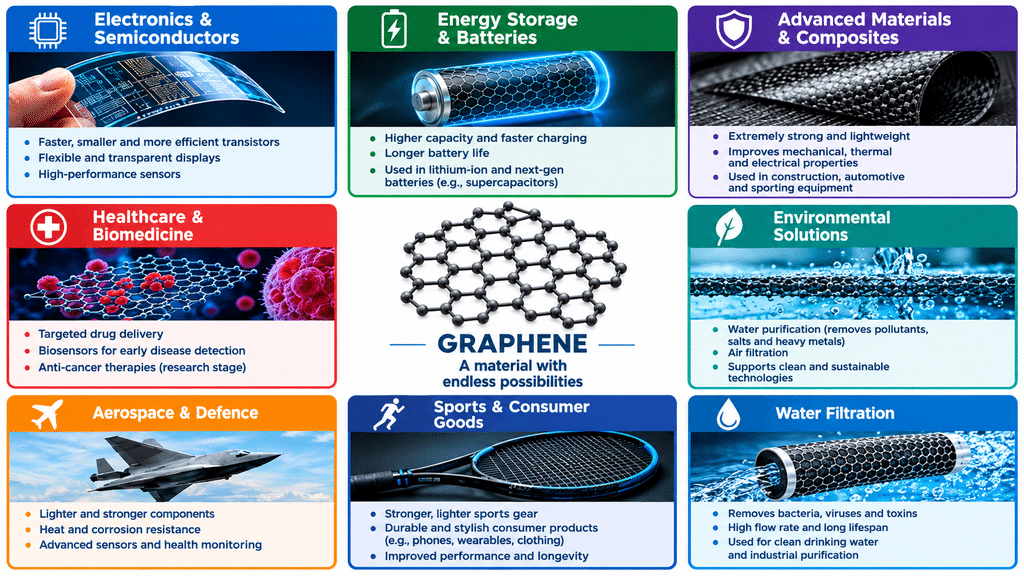
Graphene is a wonder material and it is predicted that the present decade is the decade of Graphene. It can enhance the memory of your electronic components; make your mobile phone charge fast, create a flexible mobile phone, efficient room heaters, quick conversion of an insulating surface into conductive, enhance the longevity of your paint and help your concrete structure stronger and crack free and make your surface water repellent and prevent it from sunlight. Fig. 1 lists a few important applications of Graphene.
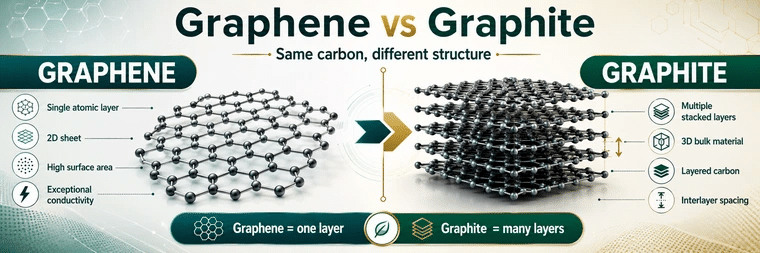
Let us first consider what graphene is? Graphene is a 2-dimensional hexagonal Carbon structure of nano size. It is synthesised from Graphite which consists of millions of graphene layers bonded together with Vanderwall forces. Graphene is, thus made from graphite by separating these graphene layers using chemical, mechanical or electrochemical methods. The best yield comes when the lamellar graphite ore is used for synthesis of graphene. There is another bottom-up approach to make graphene. In this case the dissociation of methane plus hydrogen mixture is done at 1000oC followed by the formation of carbon which is in the form of single layer. This method is directly used in making a single layer coating on electronic parts and semiconductors using an online process.
Properties of Graphene
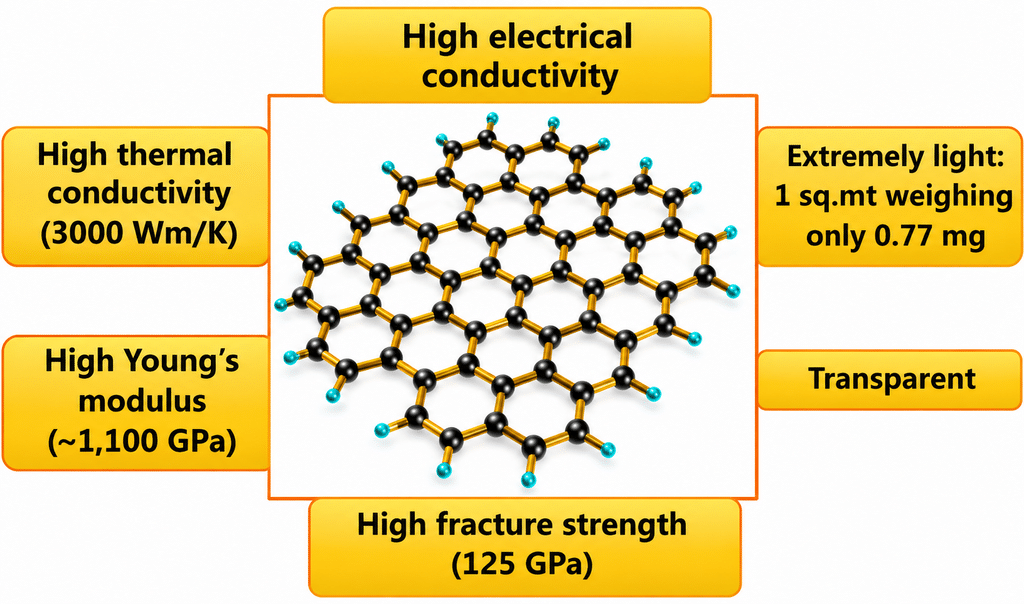
Graphene is called wonder material because of very special properties such as high heat and electrical conductivity, light, very high fracture strength and Young’s modulus as shown in fig. 2. Electrical conductivity of graphene is especially very high because it is a single, uninterrupted two- dimensional layer of carbon atoms with zero interlayer scattering. It is this property which is being exploited today to make better conducting electrical circuits, charging facilities and enhanced memory of IC’s and semiconductors.
Graphene has several advantages when added into many day-to-day products, such as paints, concrete mix, etc. Addition of 0.5 to 1% graphene in paints helps in longer durability, better strength and anti-static properties to paints [1]. Adding tiny amounts of graphene (typically 0.03% to 0.1% by weight of cement) to cement and mortar, dramatically improves mechanical strength, blocks water penetration, and cuts down carbon emissions by reducing the overall volume of cement needed.
The Key Benefits are: Higher Strength: Boosts compressive strength by 10–34% and tensile/flexural strength by up to 25–79% depending on the mix and type of graphene used. Crack Control: Graphene sheets act as nanoscale bridges that stop micro-cracks from growing. Water Resistance: Creates a dense internal structure that reduces water and chemical absorption by over 35%, preventing rebar rust. Lower Carbon Footprint: Requires less total clinker/cement to reach target load limits, lowering related greenhouse gas emissions [ 2].
The mechanism of its working is that it creates nucleation sites with Graphene particles which give cement crystals a surface to grow on evenly, forming a denser binder gel (calcium-silicate-hydrate). It fills the pores: The ultra-thin sheets fill tiny empty spaces inside the hardened cement matrix. Some of the problems one faces on the addition of this tiny graphene quantity to cement are : Clumping: Graphene naturally sticks to itself, so it needs special mixing or chemical variants like graphene oxide (GO) to spread out evenly, and Workability: High amounts of graphene oxide can make wet mortar thicker and harder to pump or pour smoothly.
Figure 4 gives the actual results from the lab test which shows a tremendous increase in the compressive strength as a function of graphene addition and also corresponding reduction in water penetration.
Today Indian roads are in very bad condition and especially during rain when they are filled with pot-holes. Thus modification of cement mortar admixture with graphene is an important suggestion.
Graphene is really a wonder material of this century. Large scale applications in various sectors enhances its importance. In electronics its use is very important and effective. In other fields its use cannot be overlooked. I consider for several day to structure deterioration and strong roads, addition of graphene looks unavoidable.
References
Karanveer, S.A., Khanna, A. S. Graphene based anticorrosive coatings for Cr (VI) replacement, Nanoscale, (2015), 1-3, p1-10.
Ali H. Alateah, Case Studies in Con-struction Materials 19 (2023) e02653
Singh, N., Sharma, V. & Kapoor, K. Graphene in construction: enhancing concrete and mortar properties for a sustainable future. Innov. Infrastruct. Solut. 9, 428 (2024).
Prof. A.S.Khanna, joined Indian Institute of Technology, Bombay in the year 1991 as Associate Professor in the Department of Metallurgy with a specialisation in Surface Engineering and Corrosion. He joined after working for Atomic Energy at Kalpakkam for almost 15 years. During his 15 years at Kalpakkam, He was selected for two most prestigious International Fellowships Humboldt Foundation from Germany and Royal Norwegian Fellowship on Science and Technology from Norway. He spent almost 26 months in Germany and Norway and achieved excellence in High Tempe-rature Corrosion, especially corrosion problems in gas turbines. Back in India at Atomic Energy, he tried to shift his focus on Teaching and Research more actively
and as Associate Professor in IIT Bombay. He started teaching Corrosion Science, Coatings, Materials Science and later Surface Engineering. He developed excellent Paint laboratory and High Temperature Corrosion Lab at IIT Bombay. He guided 27 Ph.d’s and, more than 150 Master’s and B.Tech. projects on the Topics such as Organic Paint Coatings, Smart Coatings, Nano-technology and Graphene manufacturing and concrete corrosion. He has extensive publication list with more than 350 papers in peer reviewed Interna-tional Journals, conference proceedings and technical magazines, thru’ which he has got about 4500 Citations. He has also written three books one on organic coatings and other two on high temperature corrosion. During his 27 years he made IIT Bombay a most popular centre for Surface Engineering and Corrosion Research and consultancy. He had done consultancy with most famous government departments such as Oil and Gas, DRDO, Cement Plants, Power Plants, Reliance, ONGC, Gail and many others. During his initial tenure he got two prestigious Bilateral Programs – Fellow of Japan Key Centre and a program with IAEA (1994-1999).
In addition to being active academically he also was active in promoting the message of Surface Engineering and Corrosion Protection through professional Bodies such as NACE, SSPC. He was chairman of NACE India Chapter in 2002-03 and in 2004 he started India Chapter of SSPC. He organized more than 17 International Conferences on Paint Coatings and more than 300 Training Programs on Paint Coating Inspection and Quality Control.
In 2018 he retired from IIT Bombay. Being running a excellent paint Coating lab for more than 20 years at IIT Bombay, he continued this effort by starting a paint lab initially names as Surface Enginee-ring and Coating consultant as a Reputed NABL Laboratory later changed it name to Khanna Paint Testing Laboratory, NABL accredited lab. At present he is Director of this lab. He is well travelled – to almost 23 countries to participate in various conferences, bilateral programs. and has got several National and Internal awards. He won several Awards, NACE Fellow in 2002, ASM Fellow in 2005, Life Time Achievement Award by SSPC India in 2017, Life Time achievement Award from Highest Corrosion Institute in India CECRI in 2014.
Being a dedicated Scientist, Teacher, researcher and promoter of Science and Technology in public, he is a right candidate for IIT Alumni Award (DAD)
Indian Institute of Technology
Web : www.askhanna.in