




Stalwart Cranes: Revolutionizing Material Handling with Intelligent Anti-Sway technology

Stalwart INDIA Inc.
In the modern industrial landscape, speed, precision, and safety have become the cornerstones of successful manufacturing and material handling operations. Industries today demand lifting equipment that not only moves heavy loads efficiently but also ensures maximum safety and operational reliability. As manufacturing facilities continue to embrace automation and smart technologies, overhead cranes have evolved far beyond conventional lifting machines.
Stalwart Cranes stands at the forefront of this transformation by delivering technologically advanced crane solutions designed to meet the growing demands of modern industries. With a strong focus on engineering excellence, innovation, and customer satisfaction, Stalwart Cranes offers intelligent lifting systems that improve productivity while ensuring safe and smooth operations.
Among its advanced technological innovations, Anti-Sway Technology has emerged as one of the most valuable features for industries handling heavy and sensitive loads.
The Challenge of Load Sway
Every crane operator is familiar with one of the biggest challenges in material handling load sway.
Whenever a suspended load is accelerated, stopped abruptly, or moved in different directions, it naturally begins to swing like a pendulum. This swinging motion may appear minor, but in industrial environments it can create significant operational challenges.
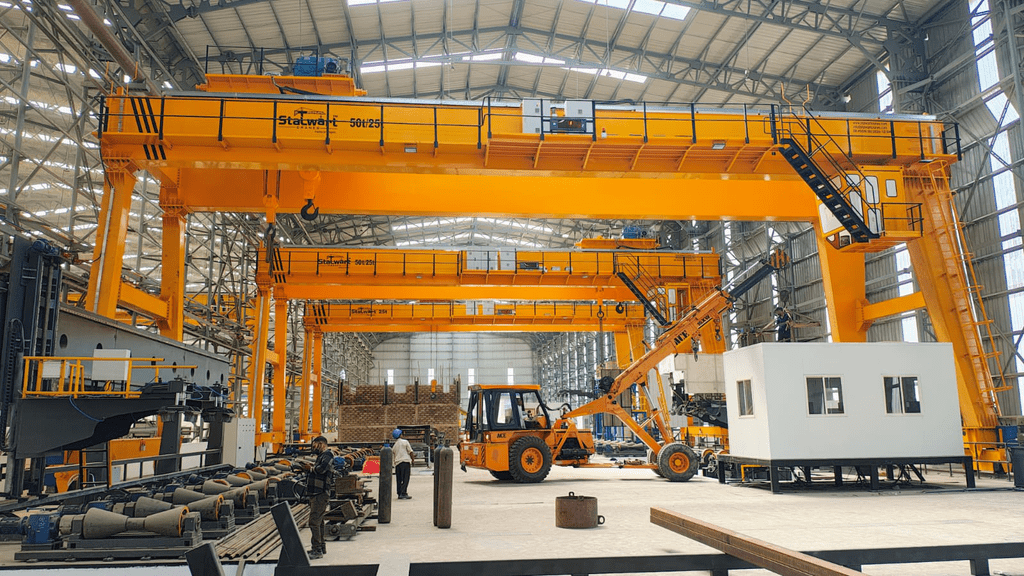
Load sway can:
- Increase material handling cycle time
- Reduce positioning accuracy
- Damage valuable equipment or products
- Increase operator fatigue
- Create unsafe working conditions
- Lower overall plant productivity
Traditionally, experienced crane operators relied on their skills to minimize load swing by carefully controlling acceleration and decelera-tion. However, as industries demand faster operations with higher precision, manual control alone is no longer sufficient.
Introducing Intelligent Anti-Sway Technology
Stalwart Cranes addresses this challenge through its advanced Anti-Sway Tech-nology, an intelligent motion control system designed to automatically minimize load oscillation during crane travel.
Instead of allowing the suspended load to swing freely, the control system continuously monitors crane movement and intelligently adjusts acceleration, deceleration, and travel speed.
The result is exceptionally smooth crane motion with significantly reduced load sway, allowing operators to position loads quickly and accurately.
This technology transforms crane operation from being highly operator-dependent into a smarter, more automated process.
How Anti-Sway Technology Works
The Anti-Sway system combines advanced drive control algorithms with precise crane motion control.
Whenever the crane starts, stops, or changes direction, the system calculates the optimal movement profile to keep the suspended load stable.
Rather than making sudden movements, the crane accelerates and decelerates in a carefully controlled manner that suppresses pendulum motion before it develops.
Because the load remains stable throughout its journey, operators spend less time waiting for the load to settle before positioning it.
The technology works seamlessly in both routine lifting operations and high-speed production environments.
Benefits That Matter
Enhanced Safety
Safety remains the highest priority in every industrial facility.
By minimizing uncontrolled swinging of suspended loads, Anti-Sway Technology significantly reduces the risk of accidents, collisions, and injuries. Stable loads create a safer working environment for operators as well as nearby personnel.
Improved Productivity
Waiting for a swinging load to stabilize wastes valuable production time.
With Anti-Sway Technology, loads reach their destination faster and require minimal settling time. This reduces handling cycles and increases overall plant throughput.
Greater Positioning Accuracy
Many industries require loads to be placed within millimeter-level accuracy. Whether positioning expensive machinery, fabricated structures, steel coils, molds, or precision components, Anti-Sway Technology enables smooth and accurate load placement.
Web : www.stalwartcranes.com
