




Catering Various Products to the Construction Sector in different parts of the world.
Unitech Structural Systems Private Limited (USSPL) is a 25 year old ISO certified company, Part of Technocast Foundry Group which is an ISO 9001/TS 16949/ OHSAS/ ISO 14001 certified with a group turnover of over INR 150 Crores.
The group has over 25 years of experience in the Engineering industry, catering Various Products to the Construction Sector in different parts of the world.
A strong team of 600 members who have excellent technical and commercial exposure and experience operates this group.
About 50% of the group turnover comes from sales in Export markets because of the consistent quality consciousness and till date has over 1000 projects completed and over 100 on going projects across India with a reputed Clientele.
All products of Unitech are designed and manufactured under a stem quality control system with updated technology machines to meet the international standards, ensuring that all the clients would receive the best value at a competitive cost and on time deliveries.
Unitech is always committed to being the leading business partner to all clients and continue to produce high quality products and services and to serve clients on time.
We Manufacture
Pot Bearings
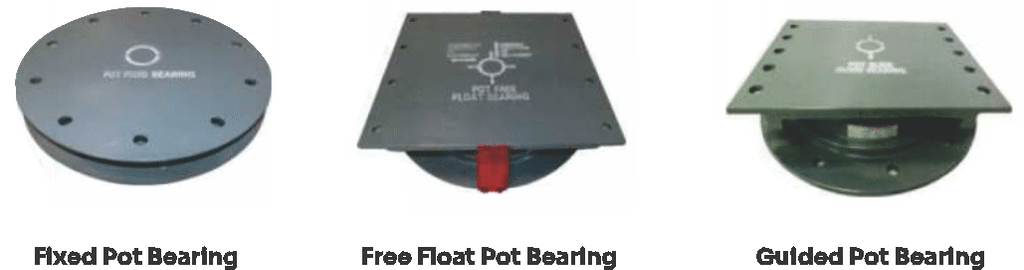
POT BEARINGS is a mechanical device which is installed between the Superstructure & Substructure to safely transmit the loads & force acting on or from the superstructure to the substruc-ture underneath while providing freedom of free translation & rotation of the structure supported of the bearing.
Spherical Bearings
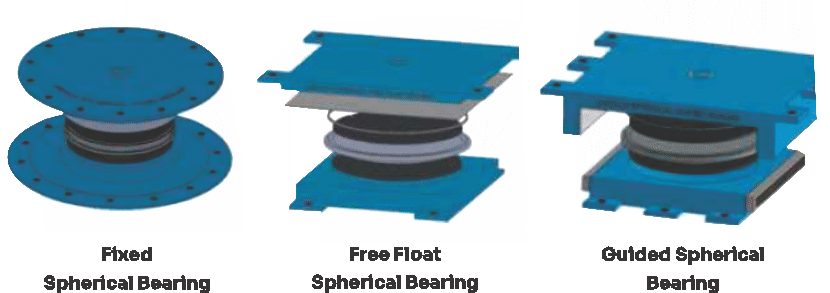
SPHERICAL BEARINGS consists of a pair of matching concave and convex steel spherical backing plates with a low friction sliding interface in between thereby permitting rotation by in curve sliding with guides for horizontal load restraining ring for resisting horizontal load & flat sliding surface.
Elastomeric Bearings
ELASTOMERIC BEARINGS supports simultaneous load and deformation in any direction. Horizontal movements up to approximately one half of the rubber thickness and Rotations are allowed by the flexibility of rubber.
Depends upon the load capacity, Elastomeric bearing divides into two categories Plain Elastomeric and Laminated Elastomeric as shown for your reference. Steel plates are bonded to the rubber through a vulcanization process and have the main scope to increase the resistance of bearings to vertical loads.
Expansion Joints
EXPANSION JOINTS are designed to allow for continuous traffic between structures while accommodating movement, shrinkage and temperature variations in reinforced, prestressed, composite and steel structures.
They stop the bridge from bending out of place in extreme conditions, and also allow enough vertical movement to permit bearing replacement without the need to dismantle the bridge expansion joint. There are various types, which can accommodate movement from 30 to > 3,000 millimetres. They include joints for small movement, medium movement, large movement or mega movements.
Parallel Thread Rebar Couplers
REBAR COUPLERS replaces overlapping of Rebar in structures with advantages of steel quantity saving, reducing process time, increased strength of joints and adding immense strength to the structure comparatively all as per IS.16172 Specification
Grout Couplers/Pre cast Grout Couplers
GROUT COUPLERS are designed and manufactured in compliance with Eurocode 2, BS 8110, ACI 318 and AASHTO, And have been designed to work with grouts commonly Available on the marketplaces.
Post Tensioning Components
Various Models & Sizes of
- Slab Castings
- Flat Slab Anchor Blocks
- Multi Strand Castings
- Multi Strand Steel Blocks
Noise Barriers
NOISE BARRIER is a structure designed to block or reduce unwanted noise from sources like highways and railways. These barriers work by either absorbing sound or reflecting it away from sensitive areas, such as homes, parks, and schools.
Noise barriers play an essential role in urban planning by helping create quieter, more peaceful environments and are often subject to regulations to protect public health and well-being.
Why do we need noise barrier?
- Noise Pollution Reduction
- Health Benefits
- Quality of Life
- Urban Planning
- Wildlife Protection
- Regulatory Compliance
Web : www.unitechss.com
